In 2014, one of the most powerful films of the decade was released: Interstellar. An original film by Christopher Nolan that utterly blew me away with its timeless messages of despair, hope, family, love, space, and time. I will write about this film separately one day, but equally matching the on-screen storytelling was the incredible soundtrack by Hans Zimmer. Probably one of his most powerful and memorable pieces to date.
What makes this OST (Original Sound Track) epic is the sound stage, the use of instruments and especially the timing. Obviously, Interstellar is deeply interconnected with the passing of time and our perception of how it works when stretched over vast distances and contexts. Interstellar always feels like it’s counting down while still counting up, as chords and church organs blend and lap, with ticking clocks, the rhythmic sound of waves, and thunder crumbling on the horizon. Every time I put it on, it transports me somewhere else. From the rolling thunder of the intro, to the deep bass of lift-off, to the subtle ticking, it is an immersive and emotional listening experience.
As the Director Christopher Nolan explains, “To me music has to be a fundamental ingredient, not a condiment to be sprinkled on the finished meal.” From the inception of the story, Nolan asked Hans Zimmer to begin crafting the music. One of the first instruments Zimmer sought was the pipe organ. As he described it, “You feel the great rasping breath inside the bellows like a monster waking deep inside the earth.” For recording, they set up a makeshift studio inside Temple Church in London, where a grand organ could bellow and control the notes Zimmer had composed.
What makes Interstellar special is the way the tracks build the emotional weight of the story. From the ‘Cornfield Chase’ to the very deep bass on ‘Dust’ and ‘Stay’, which rattles and shudders my room when I crank it up. The track ‘Mountains’ is a great example of building tension, along with the patient ticking of a clock, as organs rise to create a crescendo and give a sense of weight and impending doom. The culmination of this soundtrack builds towards ‘Coward’ and ‘Detach’, as the ticking, synths, and persistent bass reaches its climax. The measured melancholy created by ‘S.T.A.Y.’ and ‘Where we’re going’ with those punctuated organ notes, swirling winds, and
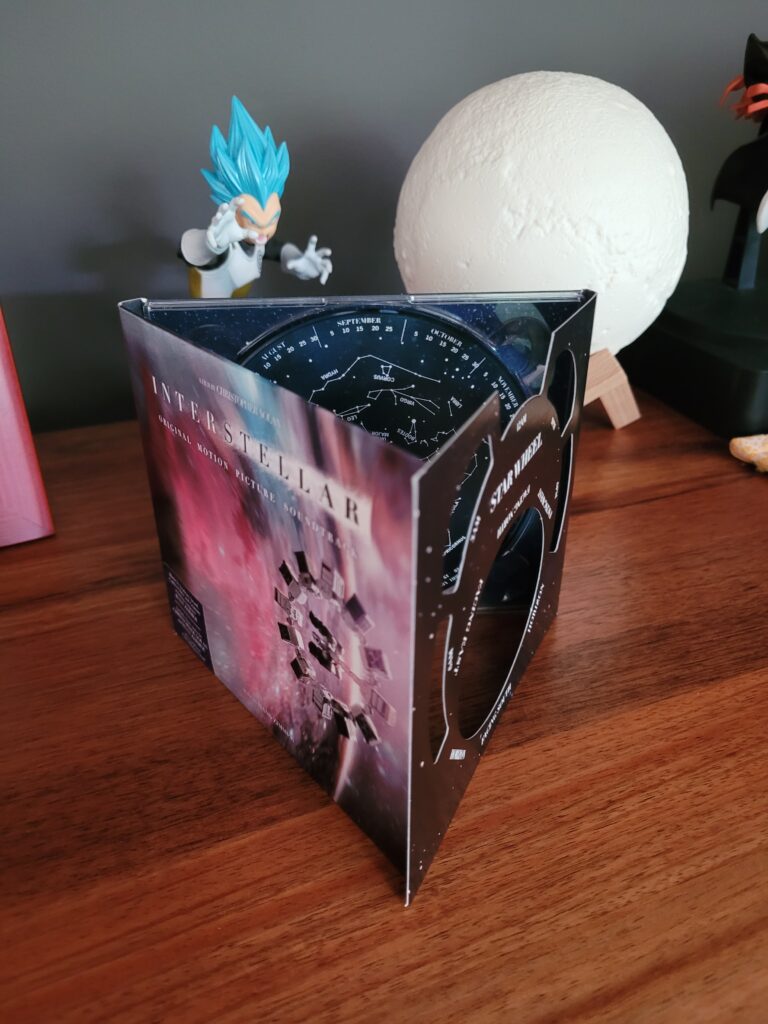
The sounds of Interstellar have become a cultural and musical icon. They’ve been played by many folk on social media, jumping onto a public piano and playing those instantly recognisable chords. Going out on a limb, but Interstellar may well be as recognisable as John Williams’ Star Wars. Zimmer has created nothing short of a masterpiece, entirely as enjoyable to listen to as it is to watch with the film. This is actually a great measure of a strong soundtrack, when it transports the listener without seeing anything. The design of the CD case itself is also very clever, with a star wheel mirroring the constellations on the disc. It rounds out the care, detail, and creative passion that went into this music, and it always remains one of those scores I put on when I want to bury myself in another time and space.